


There’s a question I find useful for separating wellness folklore from things that actually hold up: has anyone bothered to test it properly? A lot of blood sugar advice never clears that bar. This one does, repeatedly, and in the people you’d most want it tested in - which is why I wanted to give it far more room here than I gave it in my seven-minute podcast episode.
The claim is simple. The order in which you eat the parts of a meal changes how your blood sugar responds to it, even when the meal itself is identical. And it’s been measured.
The clearest demonstration comes from a team at Weill Cornell in New York. They gave a group of people with type 2 diabetes the same meal — a bread roll, a glass of juice, chicken and vegetables — on two separate days a week apart, changing only the running order. On one day the carbohydrate went first; on the other, the vegetables and protein went first and the carbohydrate last. When the carbohydrate was eaten last, the after-meal glucose rise came out roughly a third lower (around 29% lower at the half-hour mark and 37% lower at an hour) with lower insulin too. Same food, same person, same amount. Only the sequence changed. You can read the study HERE.
That was a small pilot, so the fair question is whether it holds beyond people already living with diabetes. A later study put people with prediabetes — the group I most often work with — through the same kind of test. The peak glucose rise was cut by more than 40% when protein and vegetables came first. And in separate, longer-running work where people simply ate their vegetables before their carbohydrate as an everyday habit, the benefit showed up on their HbA1c (the three-month blood glucose average) over a couple of years, not just on the day. That last point is the one that matters most, because it tells you this isn’t a one-meal party trick that washes out. Done repeatedly, it nudges the very number your GP watches. The impact of food order on postprandial glycemic excursions in prediabetes
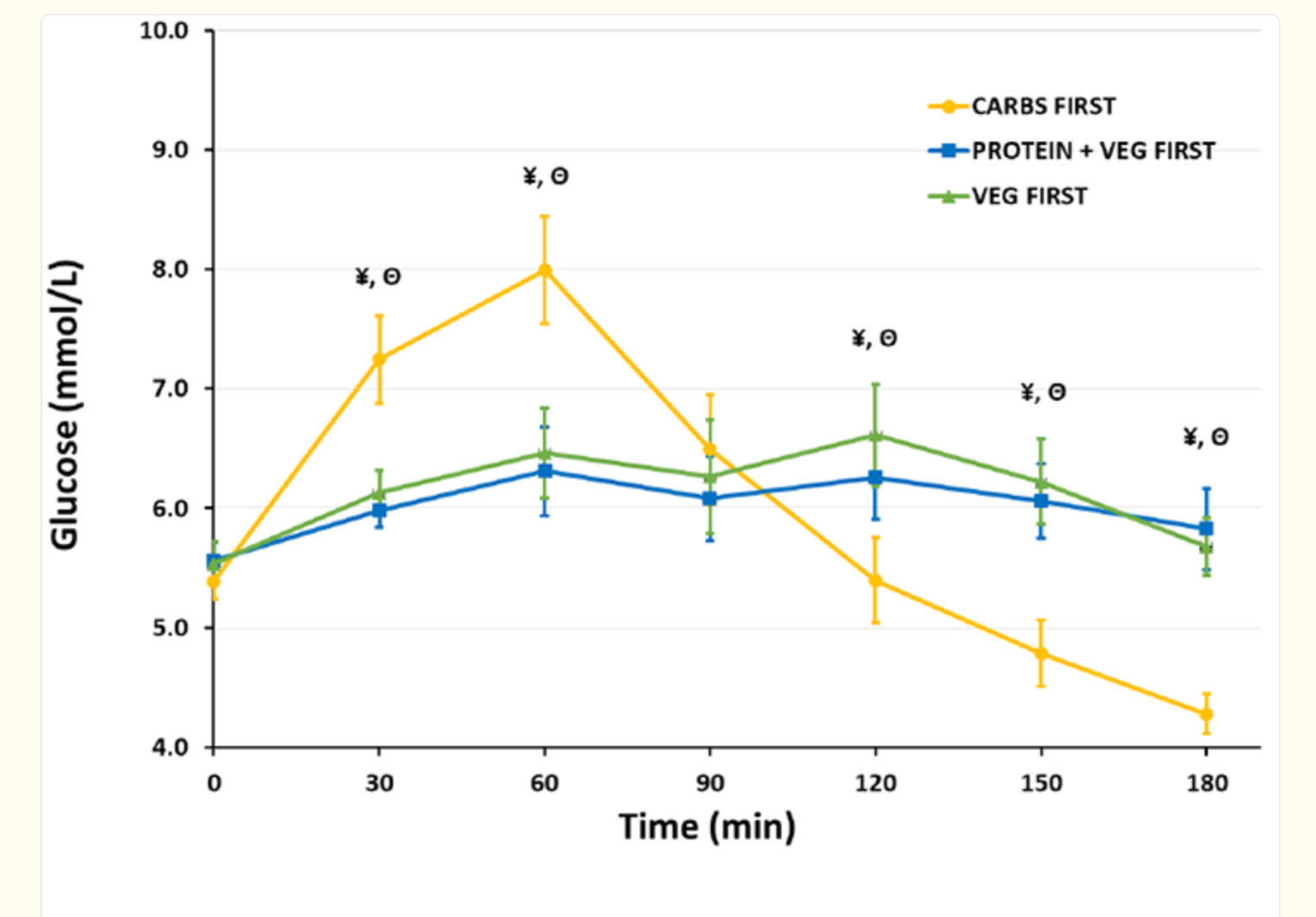
Shukla et al., 2018
So why should sequence do anything at all, when it all lands in the same stomach? Two things, working together. The fibre in vegetables forms a soft gel as it moves through the gut, and the carbohydrate that follows has to filter out through it more slowly, so glucose arrives as a trickle rather than a flood. And protein and fat slow how quickly your stomach empties, while prompting the gut to release its own hormones that steady how that incoming glucose is handled and help you feel full. By the time the bread arrives, the body’s had its warning. It isn’t caught flat-footed.
Now, the part many versions of this leave out, because it’s the honest bit. Food order is a modifier, not a magic wand. The single biggest driver of your response is still how much carbohydrate is on the plate and what kind: a meal that’s almost entirely refined starch is a lot of glucose however you sequence it, just delivered more gently. So this isn’t permission to stop thinking about the rest of the meal. It’s a free extra lever, on top of everything else, and its real virtue is that it costs nothing and removes nothing. It also matters less the more vegetable- and protein-heavy your meal already is. If there’s little fast carbohydrate there, there’s less to slow down.
One practical question I sometimes get: do you have to wait between courses? In the studies there was sometimes a gap, but in real life you don’t need to time anything or sit there with a stopwatch. Just starting with the vegetables and protein is enough.
The straightforward meals are easy: salad or veg, then protein, then the potatoes or bread last. It’s the awkward ones people ask about, so:
Breakfast is the hard case, because so many British breakfasts are carbohydrate almost top to bottom: cereal, toast, porridge, juice. The answer isn’t to skip it. It’s to give it something to go second to. A couple of eggs, some yoghurt, or a handful of nuts before the toast changes the shape of the whole morning.
One-pot meals like curry, bolognese, or soup can’t be sequenced forkful by forkful. Two options: a few mouthfuls of a side salad or some veg first, or simply build the dish itself to be properly protein- and vegetable-heavy rather than mostly rice or pasta with a little sauce on top.
Eating out: that bowl of olives or the side salad before the main isn’t only a ritual to keep you waiting. Order it on purpose.
The same principle scales down to snacks, and this is the one that changed things for me years ago. A piece of fruit on its own gives a sharper blood sugar rise than the same fruit with a little yoghurt or cheese. The fruit didn’t change, but what it arrived with did. So when you reach for something sweet, don’t strand it on an empty stomach. Give it company.
None of this asks you to eat less or give anything up, which is exactly why it tends to stick. And it works alongside whatever your GP has you doing, never instead of it. If your numbers are drifting, it’s a perfectly reasonable thing to mention to them as something you’re trying.
If you’d like to see the wider pattern of what your blood sugar might be up to, my free guide Is Your Blood Sugar Working Against You? Ten Signs Most People Completely Miss is here: francesnorgate.com/#bloodsugarguide. And if you’d like a proper conversation about your own picture, my free 30-minute Blood Sugar Audits are open now: francesnorgate.com/blood-sugar-guide.
Thank you for being here.
See you next week,
Frances x
Frances Norgate
Qualified Nutrition and Lifestyle Advisor


