


I’m guessing this might be a pattern almost everyone recognises. A stressful stretch arrives, and your digestion, which had been behaving, falls apart. Bloating, cramping, digestion moving too fast or too slow. Nothing about your what you eat has changed; you go hunting through your diet for the culprit, find nothing, and feel baffled. Or you start eliminating different foods, only to find you feel no better. Perhaps the culprit was never on your plate; perhaps it was the state you were in when you ate.
Your gut is listening to your brain
Your gut and brain are in constant two-way conversation through a communication network, often called the gut-brain axis, running in both directions all the time. Your gut doesn’t just digest in isolation; it takes its cues from what your brain is signalling about the wider situation. And the switchboard for a lot of that is the automatic part of your nervous system, which runs in two main gears.
One is “rest and digest”: the calm, parasympathetic state, and the name is the whole point. This is the only gear in which your body properly gets on with digestion: blood flows to the gut, acid and enzymes are produced, and the muscular waves that move food along (called peristalsis) run in their orderly rhythm. The other is “fight or flight”: the stress state, and when your body flips into it, it inhibits gut activity to prioritise dealing with the perceived threat. A detailed physiological review sets this out clearly: acute stress rapidly primes the body for action and dampens gut motility via adrenaline and noradrenaline, while the stress-hormone (HPA) axis drives changes to the enteric nervous system, gut motility, sensation, the gut barrier and the microbiome. In plain terms: stress physically changes how your gut works.
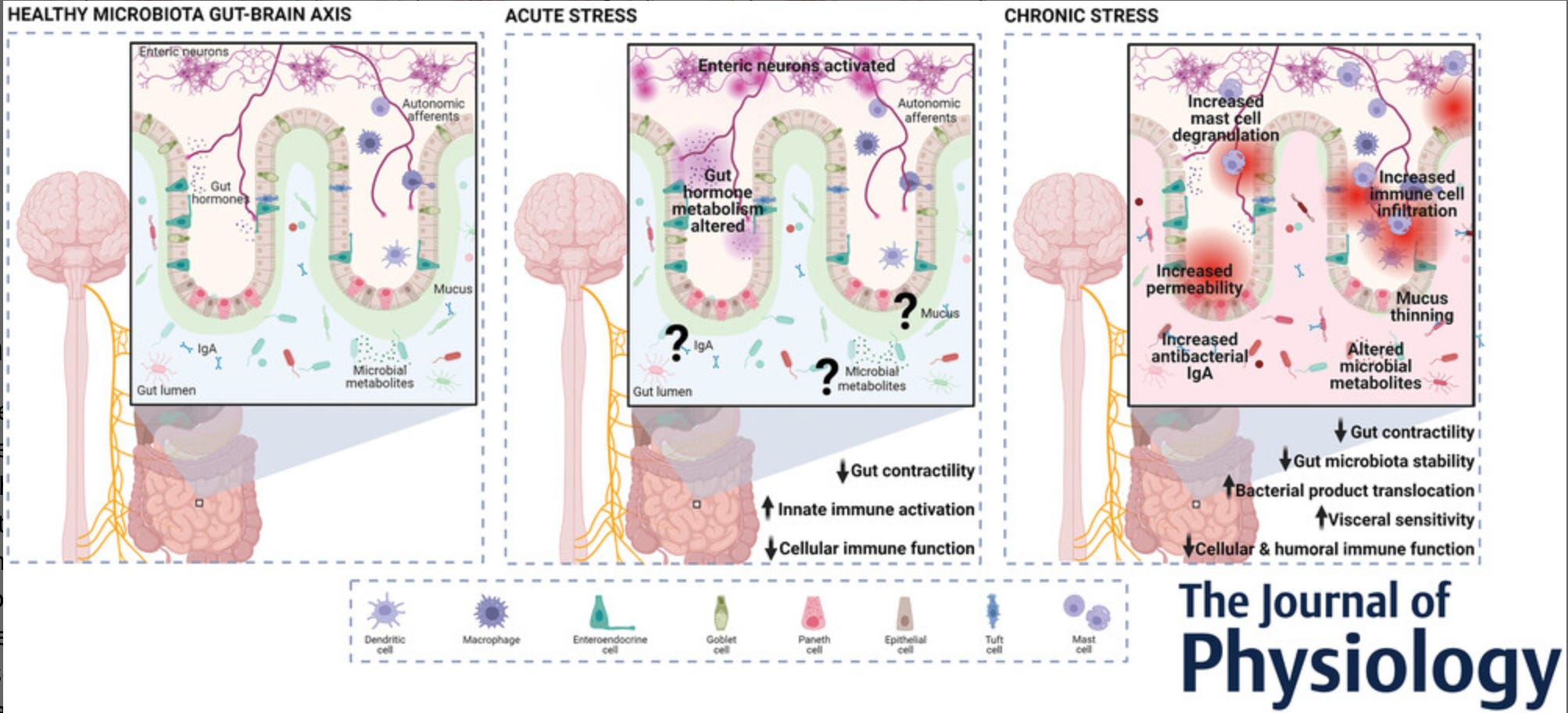
Leigh et al., 2023
Why the same food behaves differently
So when you’re stressed, blood is diverted away from the gut towards the muscles, digestive rhythm becomes erratic, acid and enzyme output shift, and over time even the gut barrier and bacterial balance can be affected. Which is exactly why identical food, eaten calm versus eaten stressed, is handled so differently. You didn’t change the food; you changed the physiological state that met it. A meal isn’t only what’s on the plate; it’s also the gear your body is in when it arrives. Eat a genuinely gut-friendly meal hunched over a laptop, tense and firing off emails, and you’ve served good food to a body in the wrong mode to use it well.
The blood-sugar double-hit
This matters doubly on a metabolic health publication, because the same stress response that parks your digestion also raises your blood sugar directly: cortisol and adrenaline push glucose into the bloodstream to fuel a fight or a sprint - so stress lifts blood sugar with no food involved at all. A stressful period is therefore a double hit from a single source: digestion shoved aside, and blood sugar nudged up. Two of the things much of my work is about, both worsened by a nervous system that’s stuck in the wrong gear.
The fix costs nothing and removes no food
The whole aim is to meet your meals in “rest and digest” rather than “fight or flight”, and you guide yourself there with small, unglamorous things:
Sit down to eat: properly, at a table where you can, not, standing at a counter, pacing or driving. That alone signals “settled and safe”, not “emergency”.
Take a few slow breaths before the first bite: A few long exhales are one of the fastest ways to shift your nervous system into the calm gear - you’re telling your body there’s no dangerous animal, it’s just dinner. I personally like the 4-7-8 breathing (in for 4 counts, hold for 7, out for 8).
Put the screens away for the 20 minutes it takes to eat.
Chew, and slow down: Digestion starts in the mouth, so rushing makes the job harder for your gut.
None of that is a diet, and not one of them asks you to remove a food (which is exactly the point).
One caveat
If your digestive symptoms are severe, persistent, or simply feel wrong, please don’t breathe your way through them and assume it’s stress. See your GP and get them properly checked — there are things that need ruling out, and that’s what they’re there for. Everything here sits alongside your medical care, never instead of it. But for that very common experience (the stressful stretch where your gut plays up though nothing about your food has changed) this is so often the explanation. It was often never a mystery ingredient, but the gear you were in. And the gear is something you can work with.
If you’d like help untangling how your digestion and your blood sugar are connected, my free 30-minute metabolic Audits are open this month.
Thank you for being here.
See you next week,
Frances x
Frances Norgate
Qualified Nutrition and Lifestyle Advisor
francesnorgate.com


