


Of the six things in this week’s episode, there’s one that always seems to make people tilt their head: eat enough. It sounds almost too obvious to count as a habit… of course you eat. But I put it in there on purpose, and it’s the one I most want to make the full case for, because it runs directly against nearly everything diet culture has ever told us. We’ve been trained to believe that less is better, that hunger is discipline, that the smaller plate is the better one. And for an enormous number of people (especially health-conscious women heading into perimenopause) that belief is actually working against them.
Here’s what’s actually going on. Your body has a certain amount of fuel it needs every day just to run the essential machinery: your hormones, your repair and immune systems, your brain, and your metabolism itself. Researchers have a name for the state where you’re consistently not covering that: low energy availability. Not eating enough, over time, to meet what your body actually needs once everything else it’s doing is accounted for. And this is the part that catches people out - you don’t have to be starving, or eating tiny amounts, to end up there. It’s remarkably common in exactly the people who’d never suspect it: the small breakfast, the coffee keeping you going until lunch, being “good” all day, and then wondering why you feel so flat and foggy and cold.
And when your body senses it’s consistently running short, it does not applaud your restraint. The research describes a whole cascade of adjustments your body ends up making: your metabolism can wind down so you burn less, the thyroid activity that sets your metabolic pace can drop, and the hormones that manage hunger and fullness get thrown off… and you tend to lose muscle, which, as I said in the episode, is your body’s single biggest glucose sponge. So you lose it in precisely the place you needed it most. And it doesn’t take months of hardship, either; even a short stretch of under-fuelling can begin to shift your hormones and your metabolism. Which is the cruel irony of the whole thing: the restriction people take on to feel lighter and steadier can leave them more tired, more stuck, foggier, and with a metabolism that’s gone into hibernation.
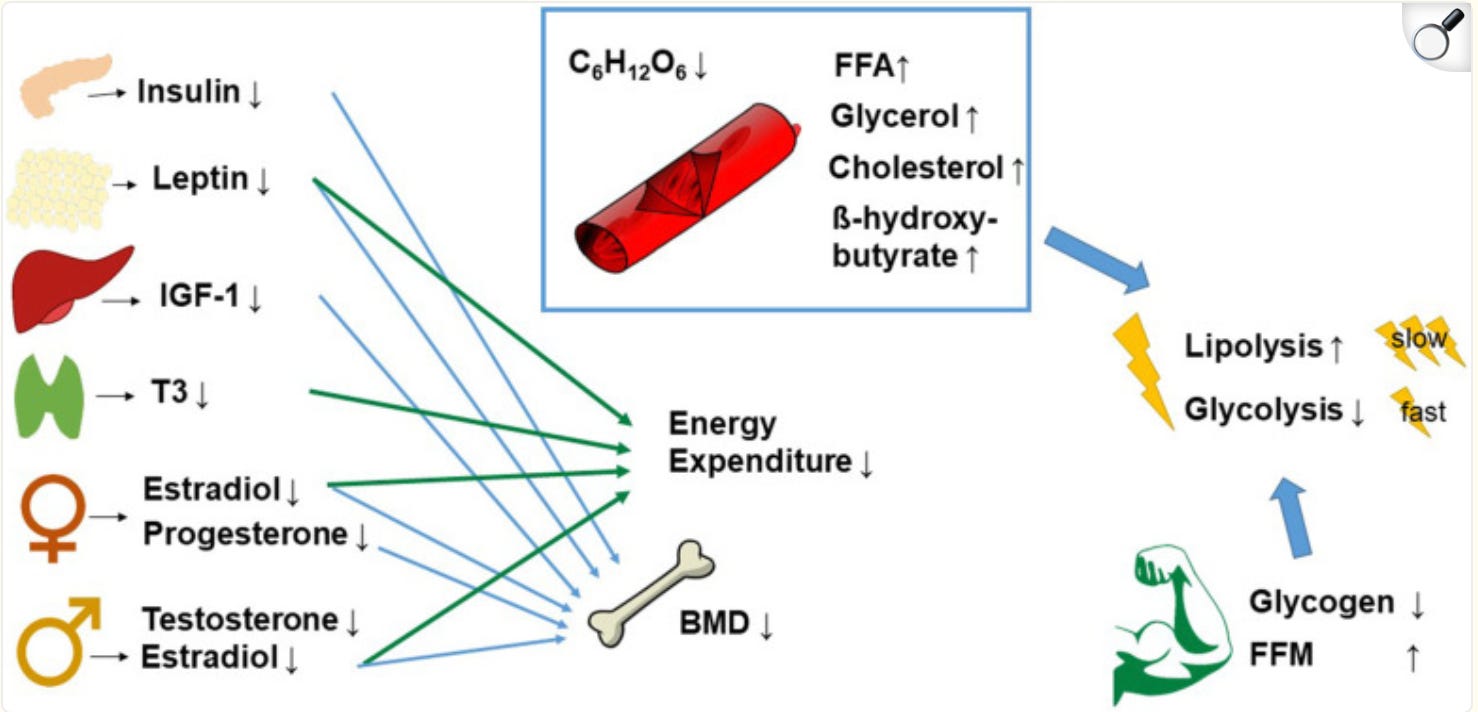
Wasserfurth et al., 2020
In perimenopause, when the hormonal ground is already moving under your feet, adding chronic under-eating on top of that is pouring effort into making the whole thing harder. And then, so often, you end up blaming yourself when it doesn’t work. It was never your effort that was the problem. It was the direction of it.
Which is exactly why I will never tell you to “just eat less”. Eating enough (real meals, enough protein, not running the whole day on fumes) isn’t indulgence, and it isn’t giving up. It’s the signal that tells your body it’s safe to run properly.
And here’s the thread that ties it to the rest of that list: eating enough is the foundation the other habits stand on. Because the reason those unglamorous ones work at all comes down to real, boring biology. After you eat, your muscle takes up around 80% of the glucose that leaves your bloodstream: it’s your biggest sink for the sugar in a meal, which is why using it, and keeping it, matters so much. Moving after you eat lets your muscles pull that glucose in without needing much insulin; a 2022 University of Limerick meta-analysis found even a few minutes of gentle walking softens the post-meal blood sugar rise. And a good night’s sleep isn’t a luxury either: pool the trials and restricting sleep reliably lowers insulin sensitivity, so a decent night’s sleep is one of the most direct things you can do for the next day’s blood sugar. Muscle, movement, sleep, and eating in rhythm with your day… none of it glamorous, but all of it is evidence-backed, and all of it is undermined if the tank is empty underneath.
If your relationship with food ever feels difficult like it’s running the show rather than you, please know that’s worth real, proper support, and you don’t have to sort it on your own. This is general education, and it always sits alongside your own medical care, never instead of it.
The whole spirit of that episode was metabolic flexibility, not metabolic perfection: a body that handles food well, rather than one that’s frightened of it. And you simply cannot build that on empty. So if you take one single thing from the six habits: before you try to do anything clever with your blood sugar at all, make sure you are actually feeding yourself. Everything else is built on top of that.
If you’d like a hand working out what “enough” looks like for you, in your real life, my free 30-minute Metabolic Audits are open this month. And if you’d like to talk about working on it properly, you can book a free discovery call at francesnorgate.com.
Thank you for being here.
See you next week,
Frances x
Frances Norgate
Qualified Nutrition and Lifestyle Advisor


