


In the episode I talked about gluten-free bread and your blood sugar, how the processed stuff is nearly always rebuilt from refined starch, and how “gluten-free” on a packet tells you what’s been left out, not what’s been put in. I promised I’d put the research in here, and I will. But first I want to go somewhere the episode didn’t have room for, because there’s a bigger question sitting under the whole gluten conversation, and the answer genuinely surprised me when I first came across it: why do so many people feel better without wheat in the first place, and are they even reacting to the gluten?
For a lot of people, the honest answer seems to be no.
However, if you have coeliac disease, this isn’t about you: for you gluten genuinely is the problem, it’s serious, it’s lifelong, and none of what I’m about to say changes a thing. Keep doing exactly what your medical team has told you. But there’s a much larger group of people who’ve been checked, don’t have coeliac disease, and yet feel noticeably better when they drop wheat: less bloated, less uncomfortable, clearer in the head. For years the assumption was that these people must have some milder version of a gluten problem. The research is now telling a more interesting story.
Here’s the thing most people don’t know: wheat doesn’t only contain gluten. It also contains something called fructans (a type of fermentable carbohydrate that a lot of us don’t fully digest). Fructans travel down to the large intestine, where your gut bacteria ferment them, producing gas and drawing in water. For sensitive people, that’s the bloating, the discomfort, the whole miserable afternoon. And when researchers finally pulled the two apart by giving people who were sure they were “gluten-sensitive” either gluten, or fructans, or a harmless dummy, without telling them which, it was the fructans that brought the symptoms on, while gluten on its own was no worse than the placebo.
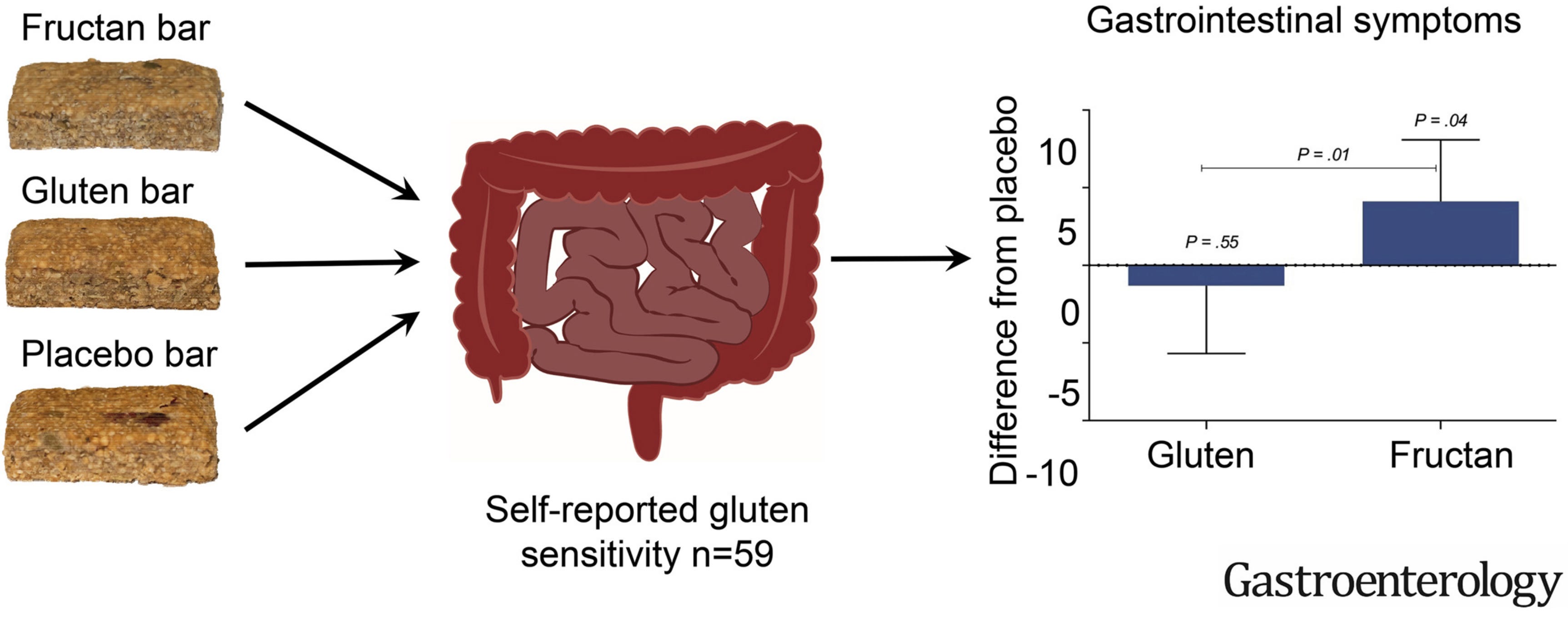
Skodje et al., 2018
Sit with that, because it reframes an awful lot. A great many people who cut out gluten and felt better may never have been reacting to gluten at all. They cut out their bread (which cut their fructans by accident), felt the benefit, and quite reasonably gave the credit to the wrong thing. It’s not that they imagined it. They just blamed the wrong thing.
And I find this actually quite freeing, because it opens a door that “avoid gluten forever” slams shut. If the trouble is often the fructans, then anything that lowers the fructans might help, and here’s the lovely part. Real, slow-fermented sourdough (the proper kind, left to ferment for many hours, not a supermarket loaf with a bit of sour flavouring or a bit of sourdough starter added to it) breaks down a large share of the fructans as it ferments. The long, slow work of the bacteria and wild yeast quietly digests them for you, before the bread ever reaches your plate. Studies have found that people who react to ordinary bread often tolerate sourdough far better even though it still contains gluten. So for some people the answer was never “no bread”. It was better bread, made the slow old way. (It’s one of the reasons I make my own though also, if I’m honest, because it’s delicious.)
Now, that’s the digestion side. Here’s the blood sugar side, and the research I promised you in the episode, because it points exactly the same way.
When you actually compare gluten-free products with their ordinary counterparts on the shelf, the gluten-free versions tend to come out higher in fat, sugar and salt, and lower in fibre and protein; which is precisely the profile that gives your blood sugar more spikes and dips. And the study I find most telling looked at people on gluten-free diets and found that the ones relying on processed gluten-free products showed less favourable changes in their blood sugar and cholesterol, while the ones eating naturally gluten-free foods didn’t. It wasn’t the gluten-free that caused the problem. It was the processed products. The people eating naturally gluten-free food were fine.
I’ll try to be fair, because the picture isn’t uniformly grim. Gluten-free manufacturing has improved, and some newer products are genuinely better made, so it varies, and it’s always worth turning the packet over rather than trusting the claims on the front of the packet. But the overall pattern is hard to miss.
So the gluten-free aisle turns out to be the wrong fix twice over. For your digestion, because if fructans are the real culprit, a rice-flour gluten-free loaf doesn’t necessarily help at all, while a proper sourdough very often does. And for your blood sugar, because the processed products are refined starch, and it’s the processed products, not naturally gluten-free food, that nudge your numbers the wrong way. Which is the same thread I keep pulling on: real food, made properly, beats the packet with the health claim on the front… for your gut just as much as your blood sugar.
This is still an active area of research and it doesn’t play out identically for everyone; if wheat genuinely troubles you, it’s worth working that out with someone who can help you test it rather than guessing, and anything persistent or severe with your digestion should go to your GP first, so other things can be ruled out. All of this sits alongside your medical care, never instead of it.
If you’d like help untangling what’s actually going on for you, with your digestion, your blood sugar, or the tangled place where the two meet, my free 30-minute MetabolicAudits are open this month.
Thank you for being here.
See you next week,
Frances x
Frances Norgate
Qualified Nutrition and Lifestyle Advisor


